Mixture decomposition
A cluster does not always come from a single phase. When the electron beam probes
several phases at once (fine intermixed powders, unreacted precursors, partly
reacted samples), AutoEMX describes the cluster as a mixture of candidate
phases (ref_formulae): which phases, and in which proportions.
Defaults: change them only if unsatisfied with the results
The decomposition runs by default and only needs the candidate phases,
ref_formulae. A phase that is not a candidate cannot be found.
The idea
Each spot measures a weighted average of the phases it probes, so the spots of a mixture fill the region between its phases:
a binary mixture spreads along the line between two phases;
a ternary mixture spreads over the triangle between three phases.
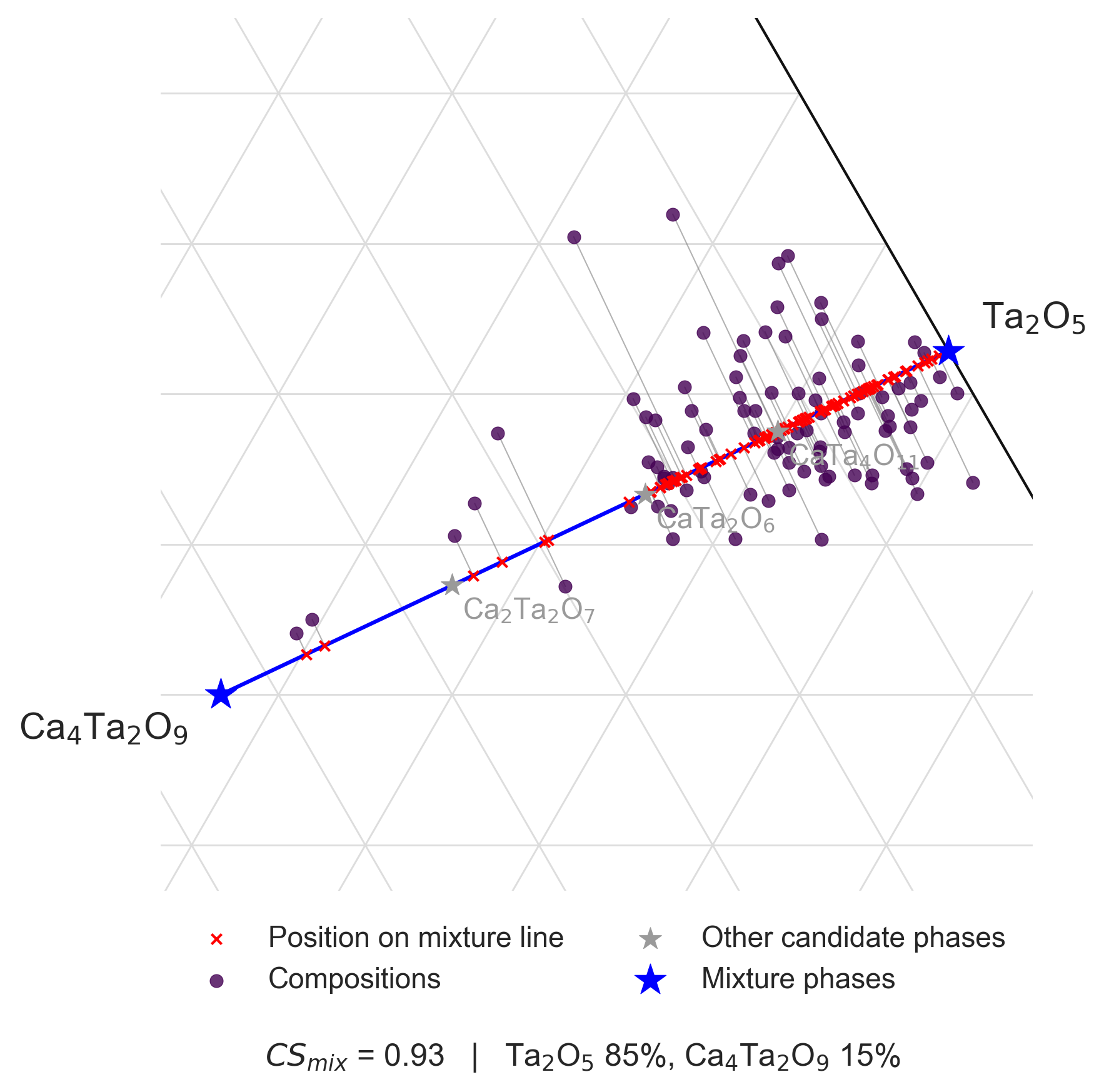
Binary. CaCO₃ + 2 Ta₂O₅ after reaction: the spots lie along the Ta₂O₅–Ca₄Ta₂O₉ line. |
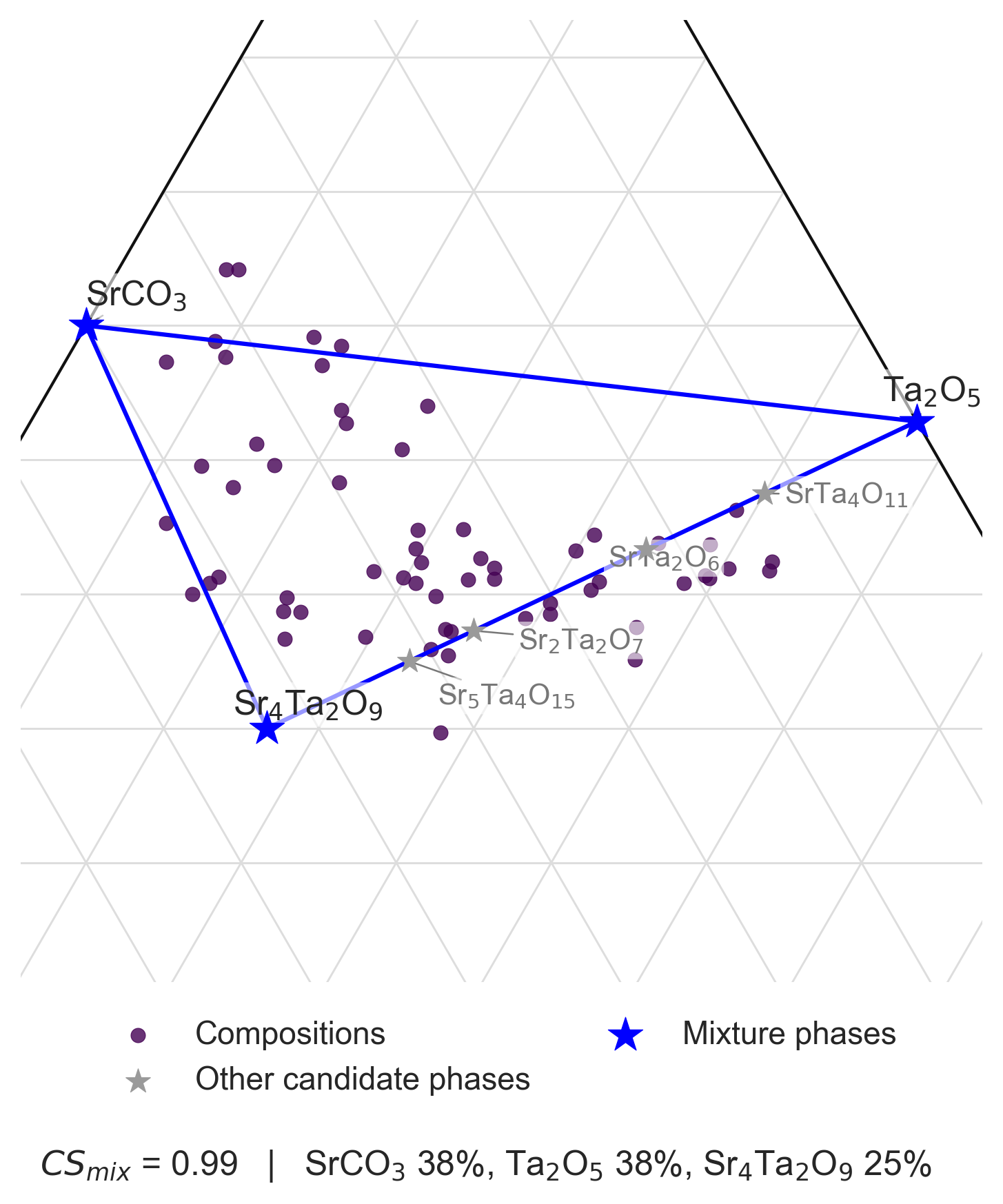
Ternary. 2 SrCO₃ + Ta₂O₅, partly reacted: the spots fill the triangle between the precursors and the product Sr₄Ta₂O₉. |
AutoEMX uses the fewest phases that reproduce the cluster: pairs first, then three or four phases only if no pair fits. Clusters that are compact and match a single candidate phase are not decomposed.
Reading the results
Each mixture in Clusters.csv gives its phases (Mix), their molar fractions
(Mol_Ratio, X_means) and a confidence score, CS_mix, between 0 and 1:
above ~0.7: the phases reproduce the cluster within measurement noise;
below ~0.5: they do not. A phase is probably missing from
ref_formulae, and AutoEMX also reports two phases of unknown composition, with approximate formulas.
Several mixtures can be listed per cluster, best first. Only the most plausible
are shown; the Mix_more row says how many more are saved in ledger.json
and why they were left out. All columns are described in Tutorial: EDS compositional analysis for phase identification.
Plots
Mixture_plot_cl<i>.png (and _zoomed) shows the best mixture of cluster
i with its phases (blue stars), the other candidate phases (grey stars) and
the spots. Check that the spots actually lie along the line, or inside the
triangle, of the reported phases.
3 elements: ternary diagram of the elements.
2 phases, more elements: the two elements that differ most between the phases (or
els_to_plot).3 phases, 4 or more elements: ternary diagram of the phase fractions.
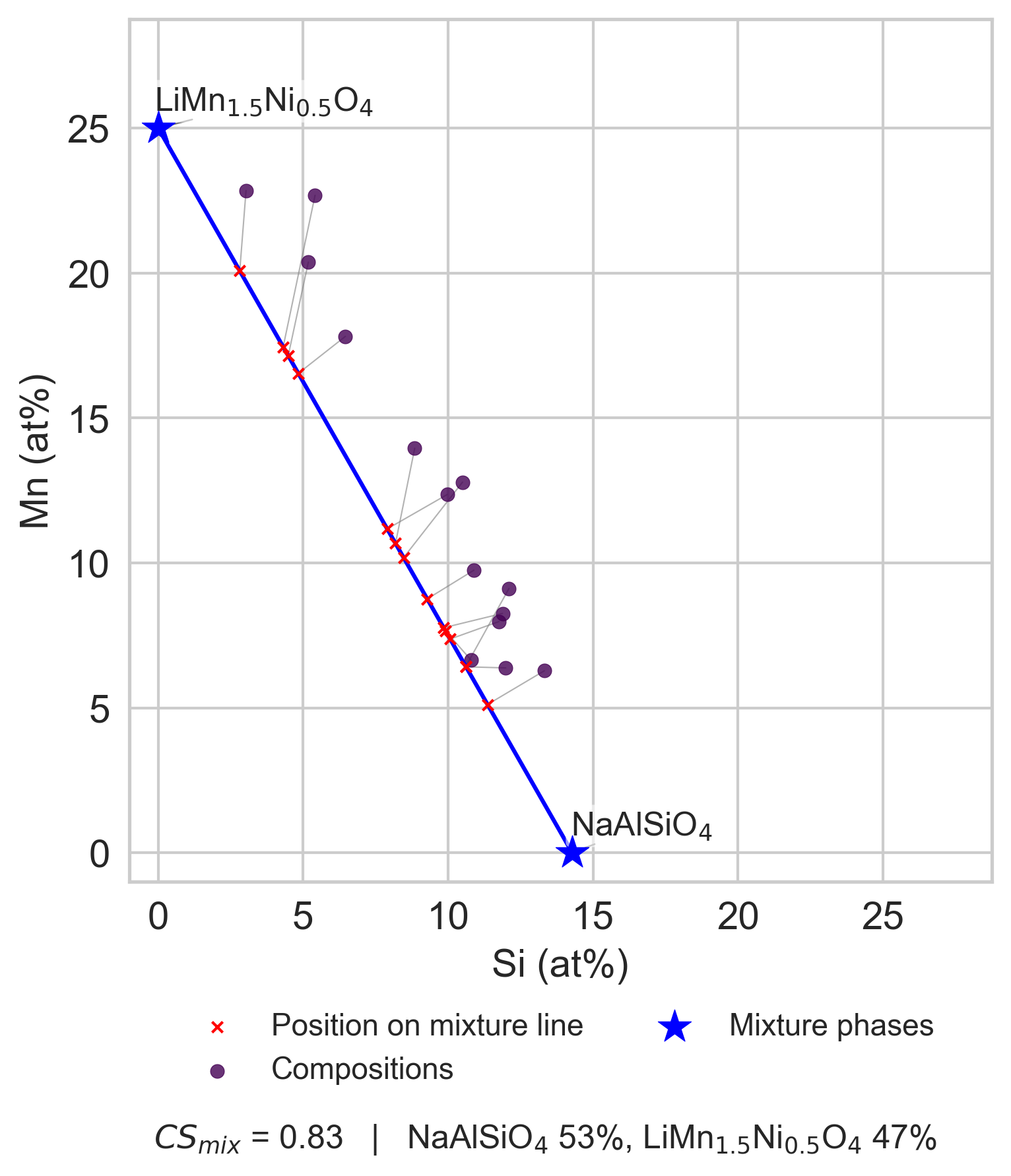
Mixture of nepheline (NaAlSiO₄) and LiMn₁.₅Ni₀.₅O₄: Mn and Si are the elements that differ most between the two phases. Each spot is linked to its position on the mixture line (red crosses), which gives its phase fractions.
For known phase mixtures (is_known_phase_mixture = True), a violin plot
of the molar fractions is also drawn. Set intermixing_violin_plots to True
or False to draw them or not regardless.
Things to keep in mind
Phases on the same line cannot be told apart. If a candidate lies on the line between two others (e.g. CuAl₂O₄ between CuO and Al₂O₃), different pairs fit equally well. AutoEMX reports the pair closest to the spots and hides the equivalent ones.
Elements that are not quantified are ignored (e.g. H, Li, and C when not in the sample): LiNb₂O₅ and Nb₂O₅ look the same in atomic fraction (
at_fr) space. They will look different in mass fraction (wt_fr) space, as the Li mass will be taken into accountWith 3 elements, three phases surrounding the cluster always fit it. A ternary result means that no pair fits, but which three phases are named depends on the candidates. Candidates close to a pure element (e.g.
CO, pure O when C is not quantified) can enclose almost anything.
Changing the defaults
The options are in MixtureParams, passed through
analyze_sample. The most
useful one:
analyze_sample(sample_ID, mixture_params={"max_n_phases": 2}) # binary mixtures only
Use it when a mixture you know is binary is reported with three phases, and the
third phase is not plausible in the mixture plot. The other options are listed
in the MixtureParams docstring.